Friday, July 19, 2019

What happened to Walter

Walter John Wolters was born in Swan River Township, Morrison County, Minnesota on December 3, 1913. His parents, George and Karin Wolters, lived on a small farm in Swan River Township, about 2 miles north of Elmdale, Minnesota. Walter was the 8th of 11 children in the Wolters family. His grandparents, Hans and Anna Catherine Wolthers Hansen and Hans and Dorthea Rasmussen, lived and farmed nearby as did numerous other extended family members.

Walter and his entire family were part of the congregation at The Danish Lutheran Church in Elmdale. The pastor often referred to Walter and his younger brothers Nels and Noah as the "Larsen Boys", in reference to Karin's remarriage to Hans Larsen following George's death in 1927. At that time, Walter, 14, and Nels, 12, were close.


Walter is wearing a black hat just behind his brother Nels in this family photograph.

At age 28 Walter married Beatrice Dickson on March 3, 1942, in the community of Vawter, Minnesota. Near Royalton, Vawter is separated from the Wolters farm by about 15 miles of farmland and the Mississippi River. The young couple lived at the home of Beatrice's parents near Vawter. They had no children.

Walter volunteered for military service in February or March of 1943. He contracted meningitis at Jefferson Barracks, St Louis, Missouri and died March 14, 1943. He is buried with a military headstone in a corner of the Dickson family plot at Riverside Cemetery in Royalton, Minnesota.


Wednesday, January 23, 2019

More bowls

I have been turning again.  In the past I have made a lot of stave bows. They appeal to me because the setup, once it's done, is easy to use and makes an easy to turn bowl. I can use nearly any wood as long as it is at least 3/4 inch thick. The last two of these were made for donations and were made from scrap plywood. The plywood gives rise to some very interesting grain and layer patterns.


I have also restarted turning bowls from a solid chunk of wood. While I was using staves to make bowls, I neglected this side of the sport.  Last season, I purchased a D-Way hollowing tool. It has a replaceable carbide tip and is design to reach into a deep bowl to turn the inside surface. There is still a lot of practice needed on the D-Way but I have time and motivation to do just that. The two bowls pictured below were turned from mesquite that Dan salvaged from some trees cut down over a year ago near the Coca Cola plant in Tucson, Arizona. 


The mesquite shows the result of a difficult life in the desert. Everything has cracks and whorls, without super glue and epoxy this would be difficult to turn. The larger piece above has aged a couple months longer than the smaller bowl and is redder. They will both slowly develop a red patina on exposure to air.


Keep 'em running.
As always,
The GlassStacker's Assistant

Tuesday, August 25, 2015

The Tower View Model of the Solar System

Red Wing, Minnesota  25 August, 2015

In the spring of 1999, students and staff at Tower View Alternative School in Red Wing designed and began construction of a 1:600,000,000 scale model of our solar system.  The model was completed over 3 school years and is located on the grounds of the Anderson Center for the Arts and along the Cannon Valley Trail.  Markers for the Sun, Mercury, Venus, and Earth are placed within the Marshall Reforestation Project Sculpture Park on the grounds at the Anderson Center.  The remaining planet markers can be found along the south side of the Cannon Valley Trail between the Tower View campus and a point approximately 1.5 km west of Welch Station.
Each marker conforms to the 1:600,000,000 scale of the model in image size and location.  The solar marker is a 2.3 meter diameter sundial that is placed in the Marshall Reforestation Project.  Individual planetary markers are cast concrete blocks bearing a scaled representation along with the name of each planet.  Pluto is included in the model as it was considered a planet at the time of the construction.

The Sundial at Tower View
N 44 degrees, 34.335 minutes
W 92 degrees, 38.333 minutes


Mercury
N 44 degrees, 34.292 minutes
W 92 degrees, 38.376 minutes


Venus
N 44 degrees, 34.247 minutes
W 92 degrees, 38.385 minutes


Earth and Moon
N 44 degrees, 34.245 minutes
W 92 degrees, 38.470 minutes


Mars
N 44 degrees, 34.436 minutes
W 92 degrees, 38.446 minutes


Jupiter
N 44 degrees, 34.391 minutes
W 92 degrees, 39.212 minutes


Saturn
N 44 degrees, 34.203 minutes
W 92 degrees, 40.014 minutes


Uranus
N 44 degrees, 33.144 minutes
W 92degrees, 41.603 minutes


Neptune
N 44 degrees, 33.785 minutes
W 92 degrees, 43.943 minutes


Pluto
N 44 degrees, 33.239 minutes
W 92 degrees, 45.379 minutes


Thanks to the following:
Jones Family Foundation
Anderson Center
Cannon Valley Trail
Red Wing High School Metals Class, 1998-1999
Neufeldt Industrial Services
Tower View Students and Staff, 1998-2001

Wednesday, November 26, 2014

Turned Wood and Pottery Shards


I scrounged around and found some old pottery pieces and put them into wood turnings. Here are some photos of the resulting jugs and crocks. All pieces are Black Walnut and Red Wing Pottery.


keep 'em running
As always
The GlassStacker's Assistant

Friday, November 21, 2014

Turned Wooden Stave Bowls

Several decades ago, I needed a baseball bat and my grandfather suggested that I make one on the lathe. He had his father's wooden bed lathe and tools, lots of scrap lumber, and the time to teach a kid to turn. Before long, turnings of all shapes and sizes were made using wood found in the shop and sheds of Grandpa's farm. There were even a couple of bats made from ironwood, which were much too heavy to be of any practical use.

Since Grandpa liked to turn bowls and plates for household use and gifts, it was a natural step for me to start turning bowls.  At first my bowls were turned from pine under his watchful eye. To get the needed swing to turn a bowl, he had reworked the old lathe so that a faceplate and tool rest could be used on the back side of the spindle.  Later, after Grandpa had passed and the Boss and I were married, we gathered oak millwork scrap ends from her father's workplace. We glued these scraps into bowl sized chunks and turned bowls using the reworked lathe. Yes, I said we. The Boss was a wood turner long before she became a glass stacker. Several of the oak bowls that we created in the '70s are in use or on display in our home.

Bowl, Red Oak, The Boss, 1975
Grandpa's rule for sizing a bowl was to make it only as big as one could afford to fill with mixed nuts.  The back side of the lathe had a swing of approximately 24 inches and was capable of turning a 48 inch piece. As a rule, bowls much larger than 15 inches in diameter and 5 to 6 inches deep were generally not made. Grandpa was very pragmatic, things had to be useful.

During the early years of our marriage I built a lathe for myself using angle iron and a rectangular tubing frame with a solid spindle mounted on a wooden table. It worked well enough but always had vibration and stability issues. I still use it for sanding and light turning but have recently purchased a well used 1922 Oliver 51-A-42 for most of my turning.

Not too long ago, the Boss and I spent part of the winter at The Resort in Mesa, Arizona. After moving in we found that the park had a very well equipped wood shop for resident use. The shop had two Jet lathes! It was like falling off the pier and landing in chocolate pudding. I was about to be turning on a professional lathe!

While we were in Arizona that winter, I did not have access to a wood pile or a millwork shop to provide a free source of scraps for turning.  Lumber had to be purchased.  To use less material, I decided to make stave bowls. I also wanted to make bowls with a prime number of segments. There was some geometry, trigonometry and a healthy dose of algebra stored in the back of my head and I just mixed that all up and fed it into the solve function of my HP 48G.  Now I have the program to quickly and exactly determine the stave length, taper, and miter angle for any sized bowl.


Calculating the numbers is only part of the operation. Next, the staves must each be accurately and consistently cut. A set of jigs are used to hold the stave while it is fed through the table saw in a series of cuts to reach its final shape and size.


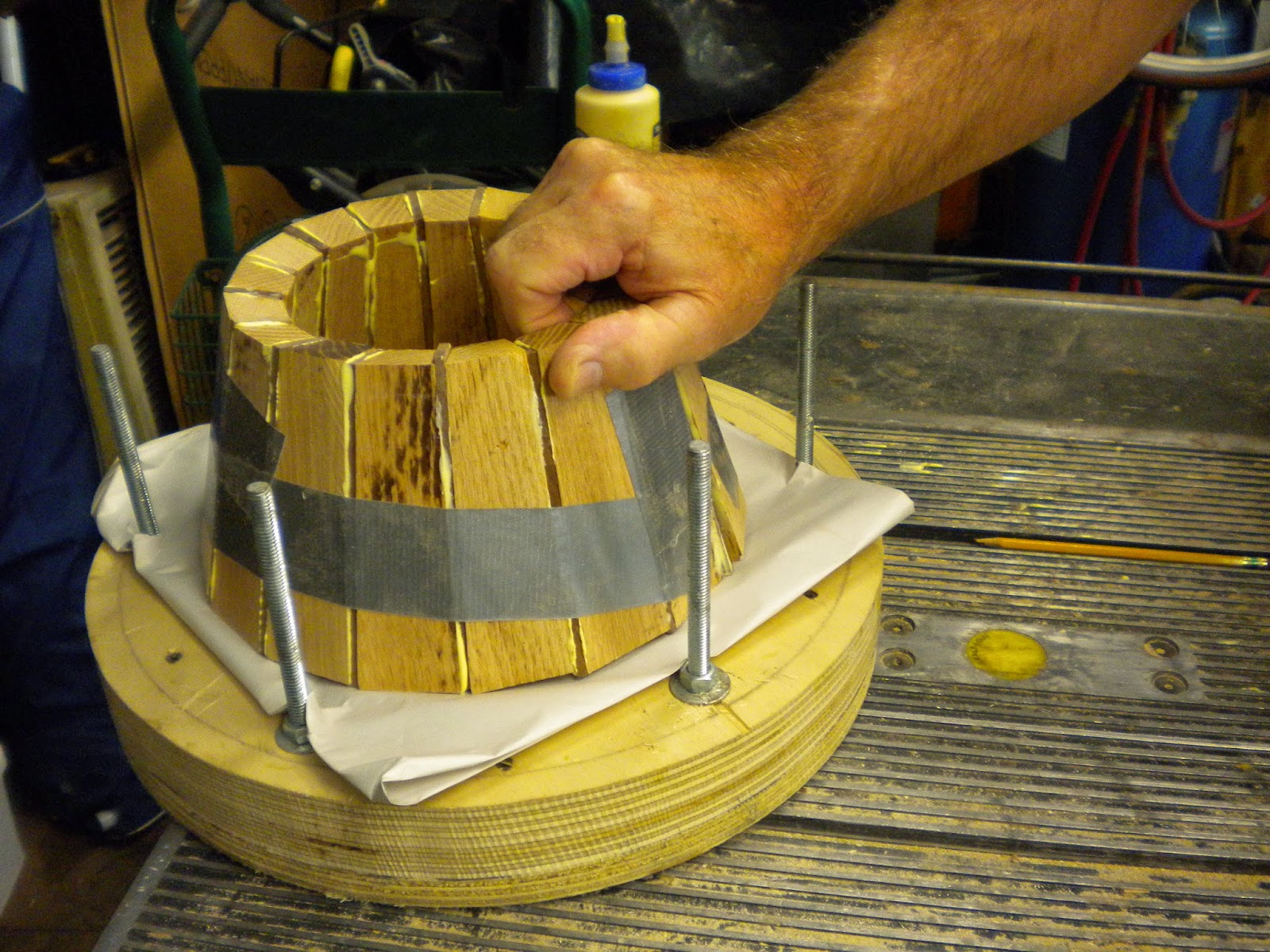
The cut staves are then assembled and glued into a bowl blank using another jig. This fixture is large enough to hold a bowl and has a socket for a faceplate on its backside so it can be placed on the lathe. The bowl pictured below has 17 red oak staves with black walnut spacers.


Bowl bottoms are made, fitted and glued in place using the fixture.


Bowls are turned to a rough shape. Then they are sanded to #2000 in steps, starting with #36.  Last, they are finished using light rubbings with very fine steel wool between each of four coats of butcher block oil.

A series of 8 bowls, Red Oak and Black Walnut, 2014

A finished bowl, Red Oak and Black Walnut, November, 2014
I made two discoveries that winter in Mesa. After purchasing several pieces of mesquite at a local woodworking store I found it to be an excellent turning wood; it is a hardwood with great finishing properties and very interesting color.  This winter I plan to visit a mesquite sawmill near Tumacacori, Arizona and purchase about 15 board feet of mesquite, enough for about 10 segmented bowls.

Bowl, Mesquite and Black Walnut, 2013
Bowl, Baltic Birch Plywood, 2013
My second discovery was plywood.  I was poking around the woodshop looking for scraps to turn and found a quarter sheet of plywood left over from a cabinet project.  I used it to make a very interesting series of stave bowls with fantastic lamination patterns.  I will do more plywood bowls in the future.

keep 'em running
As always
the GlassStacker's Assistant

Wednesday, May 22, 2013

A Day Trip to Stillwater

One day earlier this week the GlassStacker came up with the idea of a drive to Stillwater.  It is not very far, about 40 miles, and would make a good day trip.  Besides, there is a Herberger's store there and she was looking for some new flatware for our kitchen.
Always mindful of her comfort and safety, I inquired whether or not we should use our new big old Teutonic LuxoBarge.  The moment she said, "Sure, why not",  I knew exactly how Brer Rabbit felt when he was being thrown into the briar patch.  Happiness is taking a day trip in the big old TLB with The Boss in the seat beside you.

Joy was short lived on that day.  As we drove into Stillwater, the old TLB sounded an alarm gong, followed by a terse message on the dash regarding low coolant.  Of course I pulled over right away in the Lowe's parking lot.  The radiator was too hot to investigate so we decided to spend a little cool down time shopping at Lowe's for some of the other things on our list. 
Yep, the coolant was low.
Lowe's does not carry automotive stuff, but there was a Wal-Mart close by.  The Wal-Mart was just across the Lowe's mega parking lot and halfway across its own mega parking lot.  Now The Boss is always into fitness and exercise so we set off on foot across the paved fields.  Wal-Mart is arranged with car stuff on one end of the store and distilled water on the opposite end necessitating more exercise within the confines of the store.  I was also made aware of what it feels like to be 16 pounds overweight as I carried the 16 pounds of goods on the trek back to the TLB.  We got back, poured in some coolant and some water, and continued our drive into town.
Wouldn't you know it, the gong, along with the short message about low coolant were back before we had gone very far.  Quick, pull off the road into a nearby liquor store parking lot.  There is no sign of overheating and it had started raining.  In hindsight we should have called AAA right then and just hauled it all home on the back of a flatbed.
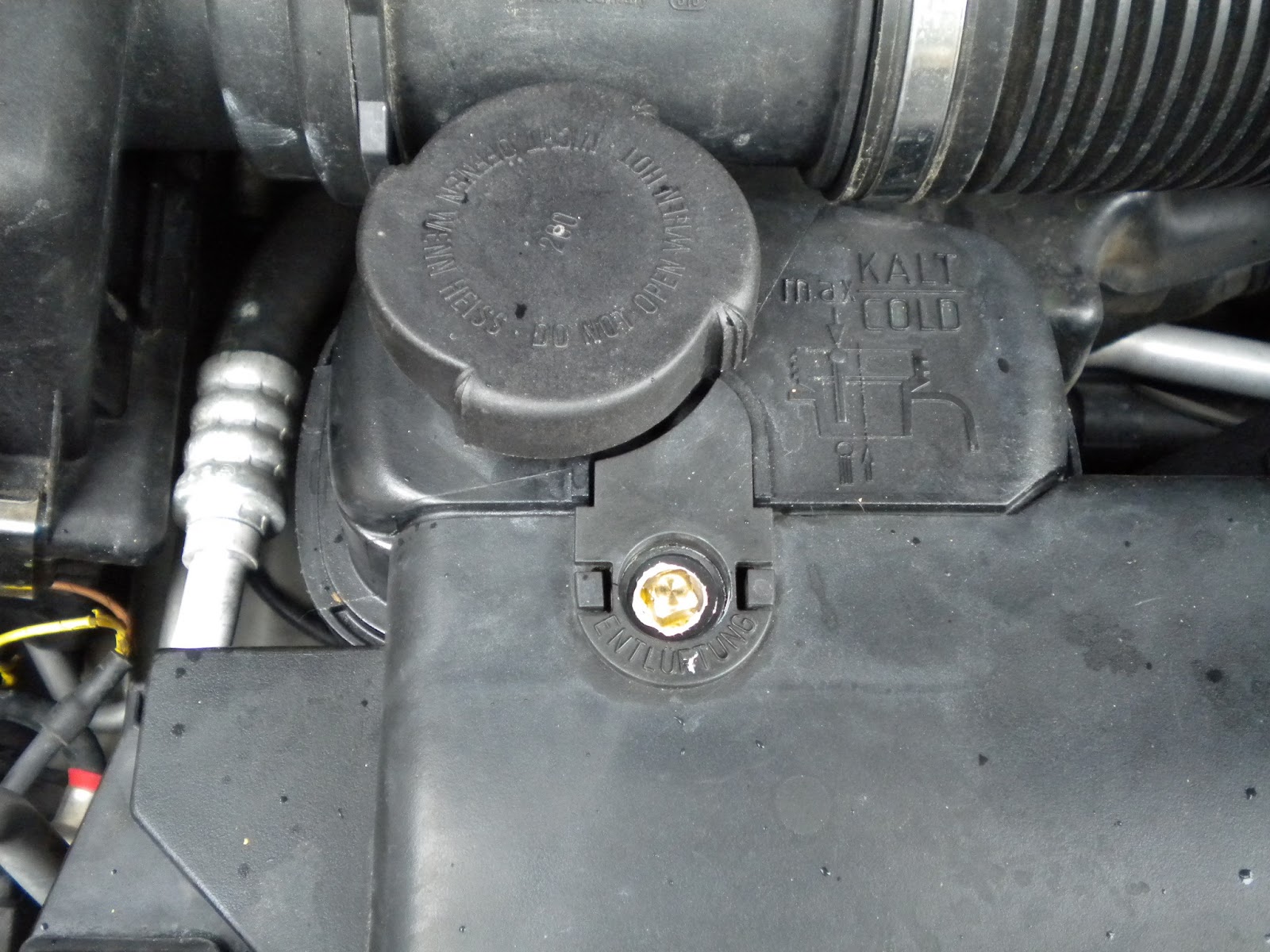
Once again the car was too warm to investigate so we waited a bit while things cooled off.  The radiator cap turned out to be faulty, a big chunk of plastic was gone from its lower edge.  My first thought was, why does this big old German LuxoBarge have a plastic radiator cap?  My next thought was, where in the whole of Stillwater am I going to find a replacement plastic radiator cap for a Teutonic LuxoBarge?  It is a good thing that The GlassStacker is pretty tech-savvy.  She quickly figured out that there was a NAPA store just a half mile or so away from our location at the liquor store and determined that they had the part in stock, at a reasonable price, and that they would hold it for us.
We took off walking again, remembering that fitness and exercise are always the order of the day.  As it was still raining we ducked into McDonald's on the way, then we decided to skip across the drive through lane to Taco Bell.  When we arrived at TB it was seriously raining so we sat and ate a bunch of tacos, she likes crunchy and I like soft, and waited for the rain to lessen.  Because now the grass has become wet, really wet, from the heavier rain, we have to walk on the frontage road to get from Taco Bell to NAPA.  Out in the street we were dodging cars and puddles and wondering if you get wetter when you run or not and eventually get to the auto parts store.  While I am paying for the radiator cap, The Boss asks the counterman for a plastic bag, she is getting concerned about the effect of so much rain on her smartphone.  It is still raining when we start walking/running back to the liquor store parking lot.  As a note of interest, I do not look anywhere near as good when I am running as the GlassStacker does.  She is really graceful.  A few minutes later I have poured in some coolant and some more water and we are again heading for downtown Stillwater.
Arriving downtown, we parked in a 3 hour spot on the crowded main street near a coffee shop.  While docking the barge, I noticed that the radiator was emitting some vapor, I could just see the little puffs between the raindrops.  Oohh, not good.  When I opened the hood, the first thing I noticed was that the bleed screw on the top of the radiator was broken and coolant was bubbling out in a big way.  Oohh, really not good.
The bleed screw is a little plastic screw plug used to remove air from the cooling system, NAPA doesn't have one, the car will not run without it, and why is it made of plastic on a big old TLB in the first place?  You might guess that it was still raining.  We went into the coffee shop, bought a medium sized cup of dark roast coffee and sat down to think about our day trip to Stillwater in the big old Teutonic LuxoBarge to buy some flatware for our kitchen.
What we needed at that moment was an old fashioned hardware store.  Stillwater is a tourist town and the downtown area has a lot of restaurants and little shops and cute stores that sell potpourri and antiques.  The hardware store is in the new part of town, up on the hill by the Lowe's, a couple of highway miles away.  Too far to walk.  Call a taxi.  Wait 25 minutes in the rain for the cab to arrive.  A $15 cab fare gets us to Ace Hardware.  The plug is a 10 mm diameter with a thread pitch that is not available at Ace Hardware.  Buy a 1/8 NPT brass plug - because it is close to the right size - and a small tube of RectorSeal thread dope.  Call the cab company.  Wait 25 minutes for the cab to arrive.  Eat a bag or two of hardware store popcorn.  A $15 cab fare gets us back downtown.  The car hasn't been ticketed or towed yet.  Lightly coat the threads on the brass plug with the RectorSeal and carefully screw it into the plastic tank on the top of the radiator.  Top up the coolant.  Head for home.   The gong and the terse message quickly reappear.  Stop.  Let the car cool.  Go to the Wells Fargo ATM across the highway from Lowe's to replenish our depleted cash.  Check for leaks.  Top up the coolant.  Head for home.  The gong and the message are there again.  Stop.  Check for leaks.  Top up the coolant.  Head for home.  Drive the rest of the way home without incident.  Converse with The Boss during the quality time afforded us during the drive.  Now, a couple of days later, the pipe plug from Ace is still holding and I have ordered a replacement brass plug from the barge repair company.
We bought our flatware early in the day at Herberger's and had time for brunch at Perkins.
I used our new flatware for my lunch today.  Joy is here.

Keep 'em running
As always
The GlassStacker's Assistant

Tuesday, March 19, 2013

Home Again - To a Mountain of Snow

Today is the first day of spring, you cannot tell by looking out the window.  Snow everywhere.  The Boss and I are just going to hunker down and read a book, and not feel a bit guilty about anything.

Keep 'em running.
The GlassStacker's Assistant